Inquiries: [email protected]

DATA_SET_02

Non-Newtonian Fluids

In standard physics, fluids have a constant viscosity at a given temperature, a rule famously outlined by Sir Isaac Newton. Water flows like water whether you gently stir it or violently strike it. But a strange class of substances utterly rejects this premise: Non-Newtonian Fluids.

These bizarre materials change their flow behavior under stress. The most famous example is Oobleck—a simple suspension of cornstarch and water. When resting, it pools and drips like thick milk. However, apply rapid kinetic force, such as a punch or a hammer strike, and the suspended particles instantaneously lock together in a shear-thickening response.

For a brief microsecond, the liquid acts like a rigid solid, repelling the kinetic energy before melting back into a puddle. Military research labs are actively studying similar shear-thickening fluids to develop flexible liquid body armor that instantly hardens upon the impact of a ballistic projectile.
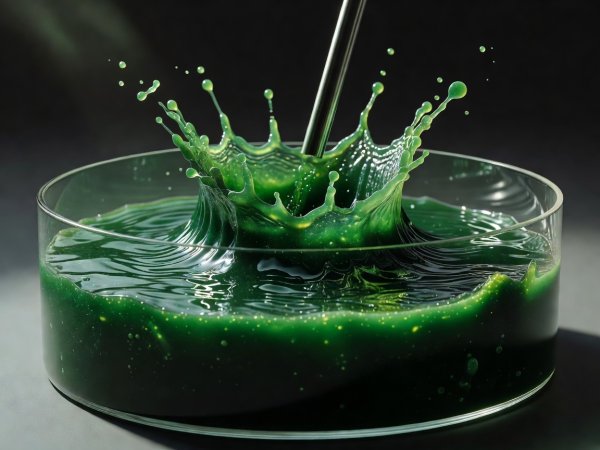
3D render of a green viscous non-Newtonian fluid reacting to an impact force

Belousov-Zhabotinsky Reaction

A mesmerizing chemical oscillator. Instead of reaching equilibrium linearly, this reaction continuously pulses and shifts colors back and forth, creating intricate geometric target patterns that look remarkably like living cellular structures.

Supercritical Fluids

When matter is subjected to extreme temperatures and pressures, it transcends the boundaries of liquid and gas, becoming a dense fog that can effuse through solids like a gas, but dissolve materials like a liquid.

THE CHEMISTRY OF EXTREMES

From the explosive reactivity of Alkali metals in water to the eerie blue glow of Cherenkov radiation in submerged nuclear reactors, chemistry operates on the edge of destruction and creation. To understand the cosmos, we must look at the bonds holding molecules together. In laboratories around the globe, chemists are synthesizing aerogels—materials that are 99.8% air but strong enough to stop a bullet—proving that the rules of density and mass are merely suggestions.